Which jobs will AI replace by 2030? We break down 15 jobs most likely to be affected by AI and automation, explain why they are at risk, and look at what workers can do to stay relevant as AI changes the job market.
Every few months, another headline claims AI is about to wipe out entire professions. The truth is messier — and more useful. This article walks through the real list of jobs AI will replace, the jobs AI may replace only partially, and the roles that are actually AI-proof, based on what AI is good at today and where it’s heading by 2030.
Table of Contents
🤔 Will AI Really Replace Jobs by 2030?
Short answer: yes, partly — but not the way most headlines describe it. The AI impact on jobs is showing up first inside job descriptions, not in mass layoffs of entire departments. AI is quietly absorbing the repetitive 30–60% of a role long before it’s capable of doing the whole job unsupervised.
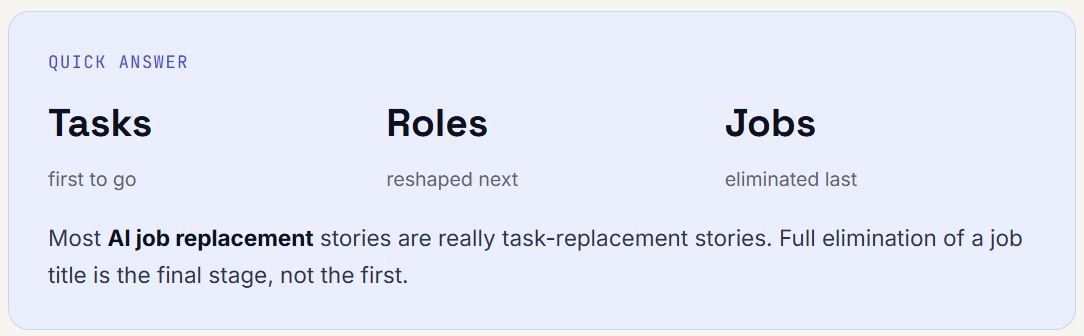
🧩 AI Is Replacing Tasks Before Entire Jobs
Almost every job is a bundle of tasks with different levels of predictability. AI automation jobs research consistently points to the same pattern: structured, repeatable tasks — data lookup, formatting, first-draft writing, basic troubleshooting — go first. Judgment-heavy tasks — negotiation, strategy, client trust, ambiguous problem-solving — go last, if ever.
Callout
📉 Which Jobs Are Most Vulnerable to AI?
The jobs most likely to be automated share three traits: the work is repetitive, the inputs and outputs are structured or predictable, and there’s little need for in-person trust or physical presence. Each job below in our list carries a risk meter based on how many of those three traits it shares.
🔀 Why Some Jobs Will Change Instead of Disappear
Not every role on the list of jobs that will disappear because of AI will literally vanish. Many will shrink in headcount, shift toward supervising AI output, or merge with adjacent roles. A bookkeeper might become an “AI-assisted controller.” A paralegal might become a “legal ops specialist” who reviews AI-drafted filings. The title survives; the day-to-day doesn’t.
📋 15 Jobs AI Could Replace by 2030
Below is the real list of jobs AI will replace, at least in large part, ranked with a rough automation-risk meter. These aren’t guaranteed extinctions — they’re the roles where AI automation by 2030 is likely to eliminate the largest share of current headcount.
Data Entry Clerks – Very high risk
This is the clearest case of jobs AI can replace almost entirely. OCR, document-extraction models, and form-parsing AI can read, classify, and enter structured data faster and more accurately than a human typist, with far fewer errors at scale.
tasks absorbed: invoice entry → form transcription → record updating
# before: 40 minutes of manual entry, one invoice batch
$ run_extraction --input invoices_q3.pdf
✔ 214 records extracted · 0.3% error rate · 6.2 seconds
# the AI didn't take the job title — it took the taskCustomer Service Representatives – High risk
Conversational AI now handles order status, returns, billing questions, and troubleshooting scripts around the clock. This is one of the most visible examples of AI replacing jobs in customer-facing roles, though complex complaints and emotionally charged calls still route to humans.
tasks absorbed: FAQ handling → order tracking → tier-1 troubleshooting
Scenario
Then: the team shrinks to 12 people who only handle escalations, refunds disputes, and angry calls — the cases where a human’s judgment and empathy actually matter.
Telemarketers – Very high risk
Scripted outbound calling is close to a worst-case scenario for job security in the AI era: repetitive, scripted, low-trust, and easy to simulate with voice AI. This role sits near the top of any list of careers AI will replace first.
tasks absorbed: cold calling → scripted pitches → lead qualification
Administrative Assistants – High risk
Scheduling, inbox triage, travel booking, and meeting notes are now handled well by AI assistants integrated into calendars and email. The role isn’t gone everywhere, but headcount per executive is dropping — a textbook example of jobs at risk from AI concentrated in coordination work.
tasks absorbed: calendar management → email triage → meeting summaries
Basic Bookkeepers – High risk
Categorizing transactions, reconciling accounts, and generating standard reports are now largely automated by accounting software with built-in AI. Bookkeepers handling only routine entries are among the jobs at risk of automation; those advising on strategy and tax planning are safer.
tasks absorbed: transaction categorization → reconciliation → routine reporting
Translators – High risk
Machine translation has closed most of the quality gap for everyday business, technical, and travel content. What remains firmly human: literary translation, legal certification, and culturally nuanced localization — the cases where a mistranslation carries real consequences.
tasks absorbed: bulk document translation → subtitle generation → routine correspondence
Content Writers – Moderate risk
Generic, templated content — product descriptions, basic SEO listicles, social captions — is now cheap for AI to produce. Writers who bring original reporting, a distinct voice, or subject-matter expertise are far less exposed, which is why this sits at moderate rather than very high risk.
tasks absorbed: first drafts → templated posts → basic copy variations
$ generate --brief "product roundup, 800 words"
✔ draft ready in 40s — needs: voice, facts checked, real opinion
⚠ human editor required before publishProofreaders and Editors – High risk
Grammar, style consistency, and basic line editing are now handled well by AI-powered tools. This is squarely on the list of jobs threatened by AI at the entry level, while senior editors who shape narrative, tone, and structure remain harder to replace.
tasks absorbed: grammar checks → style consistency → basic copyediting
Graphic Designers – Moderate risk
AI image tools handle templated social graphics, mockups, and quick iterations well. Brand identity work, art direction, and design systems that require taste and client alignment are much harder to automate — keeping this role at moderate rather than high risk.
tasks absorbed: template graphics → quick mockups → asset variations
Paralegals – High risk
Document review, contract summarization, and legal research are increasingly done by AI in minutes instead of hours. It’s a clear case of AI and the future of work reshaping a support-heavy legal role, though final sign-off still requires a licensed attorney.
tasks absorbed: contract review → case research → document summarization
Scenario
Then: an AI tool flags the relevant clauses and anomalies in under an hour. One paralegal now verifies the AI’s findings instead of two paralegals reading every page.
Junior Software Developers – High risk
AI coding assistants now write boilerplate, basic CRUD features, and simple bug fixes competently. This is one of the more debated entries in any future jobs AI discussion — the entry-level rung of the ladder is thinning, even as demand for senior engineers who can architect and review AI-written code stays strong.
tasks absorbed: boilerplate code → simple bug fixes → unit test generation
// prompt: "add input validation to signup form"
+ if (!email.includes('@')) throw new Error('Invalid email');
+ if (password.length < 8) throw new Error('Password too short');
// generated in seconds — still needs senior review for edge casesTechnical Support Specialists – High risk
Diagnostic AI can walk users through common fixes, search knowledge bases instantly, and resolve tier-1 tickets without a human. Complex, multi-system issues and enterprise accounts still need experienced engineers, but front-line volume is shrinking fast.
tasks absorbed: ticket triage → known-issue troubleshooting → knowledge-base search
Market Research Analysts – Moderate risk
AI can synthesize surveys, summarize competitor data, and spot patterns across large datasets quickly. Analysts who only compile reports are exposed; those who design studies, interpret nuance, and advise strategy stay relevant — another moderate-risk case rather than a clear-cut one.
tasks absorbed: data synthesis → trend summaries → competitor scans
Insurance Claims Processors – Very high risk
Routine claims — verifying documentation, checking policy terms, calculating payouts — follow clear rules that AI can apply consistently and instantly. This makes claims processing one of the most exposed roles among all jobs at risk from AI in financial services.
tasks absorbed: document verification → policy matching → payout calculation
Basic Financial Analysts – High risk
Building standard reports, pulling comparables, and running routine models are increasingly automated by AI-driven finance tools. Analysts who only produce spreadsheets are exposed; those who advise on strategy, risk, and judgment calls under uncertainty remain far harder to replace.
tasks absorbed: report generation → comparable analysis → routine modeling
⚙️ Why AI Can Replace These Jobs
Looking across all 15 roles, the pattern behind artificial intelligence replacing jobs isn’t random — it follows three consistent forces.
🔁 Repetitive Tasks Are Easiest to Automate
Anything done the same way, hundreds of times, with predictable inputs and outputs is the easiest target for AI automation jobs. That’s true whether the task is typing invoice numbers or drafting a templated blog post.
🧠 AI Is Getting Better at Knowledge Work
Earlier automation waves hit manual labor. This one is different: language models read contracts, write code, and summarize research — work that used to require a degree and years of training. That’s what makes this cycle of AI job replacement feel closer to home for office workers.
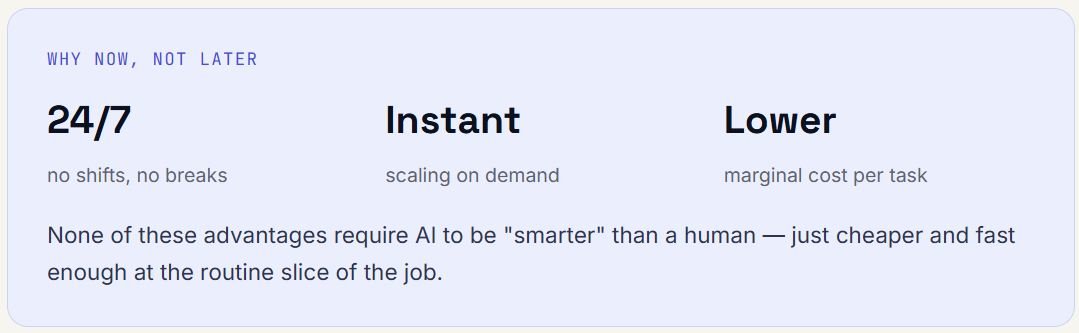
💰 AI Can Work 24/7 at a Lower Cost
Even where AI output is only “good enough,” the economics are hard to ignore: no overtime, no turnover, no training pipeline. For high-volume, low-complexity work, that cost gap is often the deciding factor in AI replacing jobs faster than skill gaps alone would predict.
🛡️ Jobs AI Is Less Likely to Replace
Not every profession belongs on a list of jobs AI will replace. Plenty of roles are structurally resistant — call them the jobs safe from AI, or at least safer, for the next decade.
🤝 Jobs Requiring Human Trust
Therapists, nurses, teachers, and caregivers rely on relationships, accountability, and presence that people don’t want to outsource to software — even when AI could technically handle part of the task.
🛠️ Jobs Requiring Physical Skills
Electricians, plumbers, mechanics, and skilled trades work in unpredictable physical environments that robotics still struggles to match affordably. These remain some of the more reliable AI proof jobs through 2030.
🎨 Jobs Requiring Creativity and Complex Decisions
Executives, creative directors, surgeons, and strategists make high-stakes calls under uncertainty, often with incomplete information and real consequences for being wrong. AI can inform those decisions — it isn’t positioned to own them.
🚀 What Jobs Will Grow Because of AI?
Every automation wave in history has destroyed some jobs and created new ones. The future jobs AI is creating tend to cluster around building, deploying, and governing the technology itself.
AI Engineers and AI Developers
Building and fine-tuning the models and systems everything above runs on.
AI Automation Specialists
Designing workflows that connect AI tools to real business processes.
AI Product and Integration Roles
Translating AI capability into usable products and internal tools.
Cybersecurity and AI Safety Jobs
Protecting systems and auditing AI decisions as usage scales.
↑ AI/ML Engineer          +38% postings YoY
↑ AI Automation Specialist +31% postings YoY
↑ AI Safety / Governance   +27% postings YoY
# net effect: jobs shift toward building and supervising AI, not just using it🧭 How to Protect Your Career From AI
You don’t need to become an AI engineer to stay ahead of the AI impact on jobs — you need to change how you work alongside it.
🤖 Learn to Use AI Instead of Competing With It
The professionals most at risk aren’t the ones AI can do better — they’re the ones who refuse to use AI at all. Learning the tools in your field turns AI into leverage instead of a threat.
🧗 Build Skills AI Struggles to Replicate
Negotiation, leadership, complex judgment calls, and hands-on physical skill are still hard to automate. Investing in these keeps you closer to the AI-proof jobs end of the spectrum.
🔗 Combine Technical Skills With Domain Expertise
A nurse who understands AI diagnostics, a lawyer who understands contract-review tools, a marketer who understands AI-generated content — hybrid expertise is consistently harder to automate than either skill alone.
😌 Should You Be Worried?
A little concern is reasonable — a panic isn’t. Most of the jobs on this list won’t vanish overnight; they’ll shrink, merge, or shift toward AI supervision first. AI automation by 2030 is far more likely to transform how these roles work than to erase every one of them in a single wave. The people most exposed aren’t in a specific job title — they’re the ones who never adapt how they work alongside the tools reshaping it.